
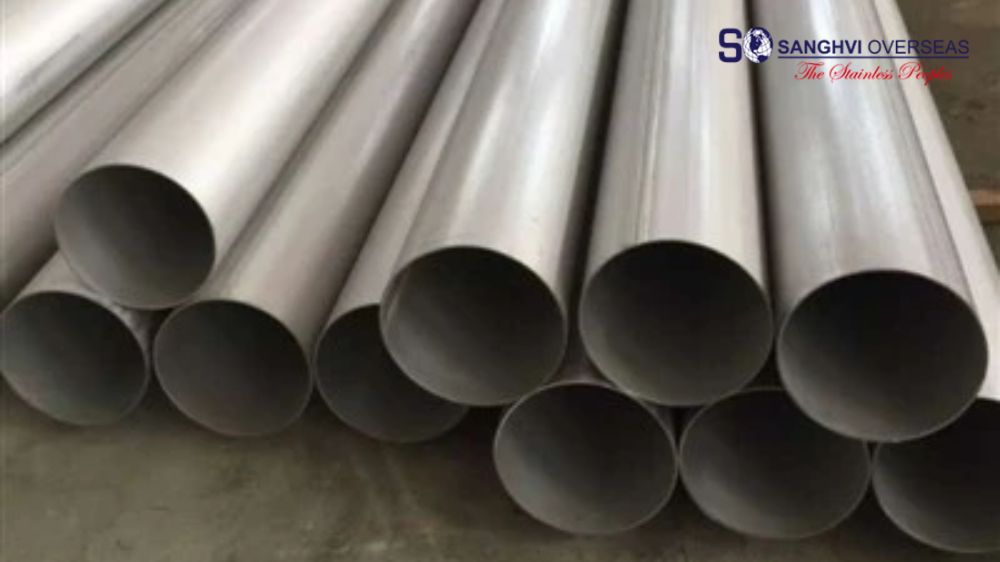
Sulfuric acid destroys most stainless grades within months, while Alloy 20 withstands harsh chemical laden enviornments. The nickel-iron-chromium alloy carries roughly 33% nickel, 20% chromium, 2.5% molybdenum and copper near 3.3%, a combination that holds up where 316L fails outright. Plants handling pickling liquor, phosphoric acid and chloride-bearing streams rely on industrial alloy 20 tubes for heat transfer and fluid conveyance. This article covers the common tube types, their properties and the industries specifying them.
What Are Alloy 20 Tubes?
Alloy 20 Tubes are hollow sections rolled or extruded from a nickel-iron-chromium base that ASTM designates as UNS N08020. Chromium builds the passive film, molybdenum blocks pitting and copper handles reducing acid attack. Tensile strength reaches 551 MPa at 35% elongation. ASTM B468 governs welded tubes, and B729 governs seamless. Seamless tube carries no longitudinal joint. Welded tube starts as a strip, rolls into a cylinder, then fuses along one seam.
Common Types of Alloy 20 Tubes
Alloy 20 Seamless Tubes
Alloy 20 Seamless Tubes begin as a pierced billet, then pass through elongation and cold drawing until they reach the final dimensions. No seam means no preferential corrosion path. Refineries specify seamless above 100 bar for cyclic duty.
Alloy 20 Welded Tubes
Alloy 20 Welded Tubes form from cold-rolled strip passing through forming rolls before TIG or laser welding closes the seam. Costs run 20% to 30% below compared to seamless type at equal dimensions. Vessel coils, vent lines and medium-pressure service suit them.
UNS N08020 Tubes
UNS N08020 Tubes follow ASTM B464, B468 and B729 depending on product form. The grade withstands sulfuric acid from 20% to 40% at elevated temperature and resists chloride stress corrosion cracking. Chemical processors quote this designation on purchase orders.
Nickel Alloy 20 Tubes
Nickel Alloy 20 Tubes hold 33% nickel specifically to counter chloride stress corrosion cracking, a failure mode that damages austenitic stainless below 10% nickel. Yield strength sits near 241 MPa. Sulfuric, phosphoric and nitric services all fall within the envelope.
Key Properties of Alloy 20 Tubes
Seven measurable characteristics explain why engineers pick this grade over 316L, 904L or duplex grades when acid service governs the decision.
Excellent Corrosion Resistance
Chromium at 20% forms a passive oxide film while molybdenum resists localised breakdown, holding rates under 0.1 mm per year in many acid streams.
High Resistance to Sulfuric Acid
Copper at 3% to 4% suppresses reducing acid attack, letting the alloy serve boiling 20% sulfuric acid and ambient concentrations near 80%.
Good Mechanical Strength
Tensile strength of 551 MPa and yield of 241 MPa allow thinner walls than softer grades, cutting weight in large exchanger bundles.
Excellent Weldability
Niobium at eight times the carbon content locks carbon into carbides, preventing chromium carbide precipitation and intergranular attack at heat-affected zones.
Resistance to Pitting and Crevice Corrosion
A PREN near 30 keeps chloride ions from initiating pits under gaskets, tube sheets and deposits where stagnant conditions concentrate aggressive species.
Good Fabrication Characteristics
The alloy bends, flares and expands into tube sheets without cracking. Cold work raises hardness, so annealing between heavy passes restores ductility.
Long Service Life
Acid plants report a 15 to 20-year bundle life against 3 to 5 years for 316L in identical duty, pushing replacement capital far out.
Industrial Applications of Alloy 20 Tubes
Acid handling accounts for the majority of demand; however, the grade is also employed wherever process chemistry is particularly aggressive toward conventional stainless steels and the cost of downtime is significant.
Chemical Processing Plants
Reactor coils, condensers and transfer lines carrying sulfuric, phosphoric and mixed acid use this grade because 316L pits within one campaign.
Petrochemical Industries
Overhead condensers and sour service piping handle chloride and hydrogen sulphide streams, where austenitic stainless steel cracks under stress.
Pharmaceutical Manufacturing
API synthesis lines and solvent recovery columns resist acid cleaning cycles without shedding iron contamination into batches worth crores.
Food and Beverage Processing
Citric and acetic acid contact surfaces in juice concentration and vinegar production survive repeated clean-in-place cycles.
Heat Exchangers
Shell and tube bundles in acid coolers use 19.05 mm and 25.4 mm diameters, expanded into tube sheets without seam failure.
Oil and Gas Processing
Amine regeneration units, sour gas separators and produced water systems face chloride and carbon dioxide attack, which the grade tolerates.
Power Generation
Flue gas condensate lines and scrubber circuits handle dilute sulfuric acid formed when sulfur dioxide meets moisture below the dew point.
Pollution Control Equipment
Wet scrubber spray headers, quench sections and mist eliminator supports resist acidic condensate across the gas cleaning train.
Benefits of Using Alloy 20 Tubes
Procurement teams weigh purchase price against replacement frequency, and these advantages explain why the higher initial cost returns value across a lifecycle.
- Corrosion rates below 0.1 mm per year in sulfuric service extend tube life well beyond 316L.
- The alloy performs in mixed acid streams where single-purpose grades fail within one campaign.
- Bundles run 15 to 20 years before scheduled replacement.
- Fewer shutdowns cut maintenance labour and inspection spend.
- Niobium stabilisation prevents weld decay, so fabricated joints match the parent metal.
- High-pressure reactor duty and low-pressure vent service both fall within the range.
- Longer replacement intervals lower the cost per operating year.
Factors to Consider When Selecting Alloy 20 Tubes
Start with acid concentration and temperature at the tube wall, not the bulk stream, because local heating shifts corrosion rates sharply. Pressure and cyclic loading settle the seamless versus welded question, since seamless suits duty above 100 bar. Match the diameter and wall thickness to tube sheet drilling and allowable stress. Confirm ASTM B468 or B729 on the mill certificate, then ask for PMI results, hydrostatic records and ASTM A262 Practice E testing before delivery.
Conclusion
Seamless handles high pressure and thermal cycling, while welded covers general service at 20% to 30% lower cost. Both deliver 551 MPa tensile strength and acid resistance that 316L cannot match. Matching Alloy 20 Seamless Tubes or Alloy 20 Welded Tubes to actual process conditions improves reliability. Sanghvi Overseas supplies both with full test documentation.


