
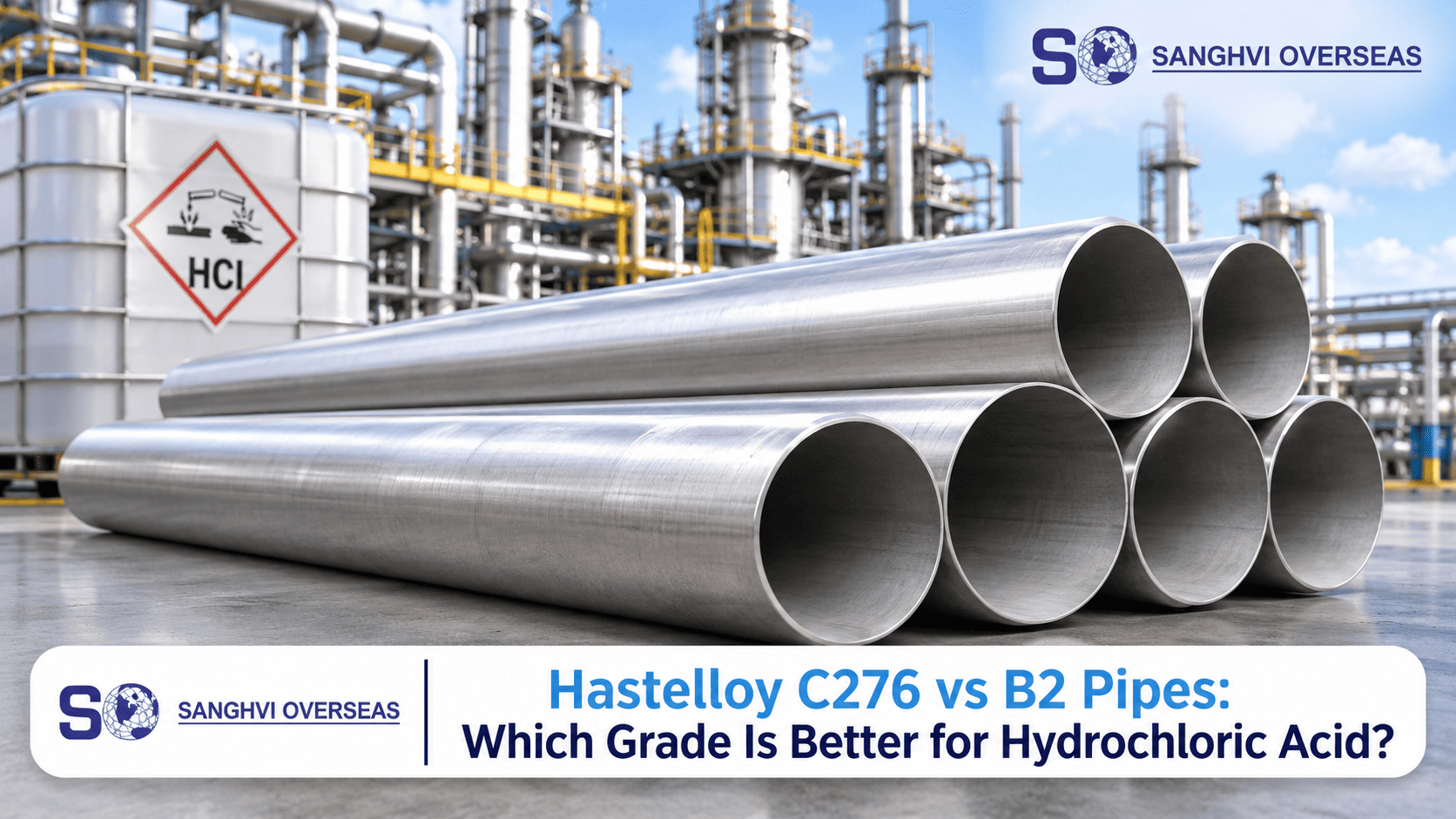
Hydrochloric acid rarely behaves the same way twice inside a process line. Concentration shifts, temperature rises, and a trace of ferric chloride turns a reducing stream into an oxidising one. Material selection carries that consequence. Two nickel-based alloys dominate the conversation, and Hastelloy pipes in grades C276 and B2 both hold strong corrosion credentials, yet they earn that reputation under different conditions. One handles chemical variety. The other targets reducing acids with far less chromium in the mix. Choosing between them starts with your process data.
Understanding Hastelloy C276 and B2 Pipes
Hastelloy C276 sits in the nickel-chromium-molybdenum family, with tungsten added to the composition. Roughly 15 to 17% molybdenum and 14.5 to 16.5% chromium give it a wide working envelope across acids, chlorides and mixed media. Hastelloy B2 takes a different route. The alloy carries around 26 to 30% molybdenum and holds chromium to 1% maximum, which sharpens resistance to reducing environments including hydrochloric acid across several concentrations.
Chromium drives the split. It builds the passive film that protects an alloy once oxidising species appear in the stream, so B2 loses ground the moment oxidisers are present. Molybdenum governs the reducing side. Composition decides which acid an alloy tolerates.
Hastelloy C276 vs B2: Key Differences
The table below sets out the factors engineers weigh before specifying either grade.
| Parameter | Hastelloy C276 | Hastelloy B2 |
| Alloy System | Nickel-chromium-molybdenum-tungsten | Nickel-molybdenum |
| Hydrochloric Acid Resistance | Strong; depends on concentration and temperature | Often preferred for reducing hydrochloric acid conditions |
| Oxidizing Environments | More versatile across mixed media | More vulnerable to oxidizing contaminants |
| Reducing Environments | Strong resistance in many conditions | Suited to strongly reducing conditions |
| Mixed Chemical Streams | Better fit where conditions vary | Requires control of oxidizing species |
| Typical Selection Priority | Broad corrosion resistance | Hydrochloric acid and reducing-acid service |
Treat these as general tendencies. Corrosion data covering your actual operating conditions settles the final specification.
How Do Both Grades Perform in Hydrochloric Acid?
Hastelloy B2 earns its place in clean, reducing hydrochloric acid, within the limits that published corrosion curves set for each concentration and temperature pairing. Purity carries the performance. Introduce ferric ions, cupric ions, dissolved oxygen or any other oxidising contaminant and corrosion rates can climb sharply, which is why upstream process control matters as much as the alloy choice itself.
Hastelloy C276 behaves differently in the same service. Chromium and tungsten broaden its tolerance when oxidising impurities or mixed process chemicals move through the line, so plants running variable streams lean toward it. Acid concentration, temperature, aeration, impurity load and flow velocity each shift the corrosion picture. Neither grade is corrosion-proof, and neither covers every hydrochloric acid concentration at every temperature.
Which Grade Is Suitable for Industrial Piping?
Specify Hastelloy B2 where the acid stream stays reducing and operators keep oxidising contaminants out. Choose Hastelloy C276 where impurities fluctuate or several corrosive chemicals share one line. Piping design weighs alongside grade. Welded joints, filler metal selection, heat input control and post-weld inspection all influence service life, since weld zones corrode before base metal does. Check alloy-specific corrosion data against your conditions before releasing the specification.
What Should Buyers Check Before Selecting Hastelloy Pipes?
- Pipe dimensions, wall thickness and the product standard required, such as ASTM B622 or B619.
- Hydrochloric acid concentration and operating temperature range, including upset conditions.
- Chemical impurities present and expected process variations across the batch cycle.
- Weldability, fabrication procedures and material test certificates with heat number traceability.
- Compatibility with flanges, fittings, gaskets and the rest of the piping system.
Conclusion
Clean reducing hydrochloric acid favours Hastelloy B2. Streams carrying oxidising contaminants, or chemistry that changes between batches, point toward Hastelloy C276. Confirm the call against corrosion data for your concentration, temperature and impurity profile. Sanghvi Overseas supplies a Hastelloy pipe and tube range in both grades, backed by material test certification. Contact Sanghvi Overseas for specifications and material selection support on your hydrochloric acid line.


